Tuesday, July 19, 2016

Mark 1:14-15 - Jesus Preaches the Gospel


The Verses

Mark 1:14 After John was put in prison, Jesus went into Galilee, proclaiming the good news of God. 15 “The time has come,” he said. “The kingdom of God has come near. Repent and believe the good news!”


My Paraphrase

After John's capture, Jesus proclaimed the gospel in Galilee. "You're wait is over. God's Kingdom is right here. Turn from sin and believe the Gospel!"


My Thoughts

Since John was a harbinger of the Gospel, his job was done. He says in other gospels that he must decrease while Jesus increases. Jesus now takes over the role as repentance-commanding prophet, but becomes so much more than that. I find it interesting that Jesus didn't just start His ministry healing people, preaching love, and doing miracles. Like. . .Listen guys, He's gonna start doing miracles in a just a few days, but He doesn't start there. He started with repentance. Repentance is super important to God, so much so that He had a guy come and lay the ground work before He even got there. 

Likewise, we cannot jump into the story of Jesus without repentance. Otherwise, He makes no sense as our Savior and just becomes another figure in history for us to study. I mean, think about it. Why did Jesus change history more than any other figure? Lots of guys have healed. Lots of guy have run their mouths for the cause of an agenda. Lots of guys have rallied for revolution. None of them are as big a deal as Jesus, because Jesus is our Savior and fulfillment of repentance. For salvation, repentance is key.

I wonder what people thought when they heard Jesus tell them that time was fulfilled. What a truly bold statement! "Your wait is over! Here I am! God's gift to all of you!" (I mean, we see people who act like this all the time. . .And. . .you know what I'm sayin'?) This was a ballsy move, not only because the message He proclaimed had a certain potential arrogance about it (arrogance only if it hadn't been true, of course), but also think about this: John had just been thrown in jail because of preaching the Gospel--which I'm sure was no secret to anyone, since "the whole Judean countryside and all. . .of Jerusalem" (vs. 5) heard him and knew about him. I wonder how many people John had openly baptized who went into hiding at this point--fearful of Herod's muscle-flexing. Fearful of what fates they might suffer if Herod caught wind of their being "John Followers." But then, just at the moment when everyone is on edge and full of anxiety, here comes his Cousin--right out in the open--yelling the same message (with a decidedly MORE poignant twist) throughout Galilee! Like, at least John did all his stuff out in the wilderness and didn't claim to be God Himself! 

I think there is a silent message within these verses that if we are to follow Christ's example truly, we definitely shouldn't fear men. If it's our time to go, then we go down proclaiming Christ. Otherwise, if it's not our time to go, there's really NOTHING anyone can do to us!

(Note: Of course in later verses we are going to see Jesus constantly telling people not to talk about Him and not to tell people about Him, but that's only after He starts doing miracles and He gets so popular it hinders His actual ministry. . .Like, hinders as in. . .not being able to walk through town because of all the people in the way wanting "a piece.")

Friday, July 15, 2016

Mark 1:12-13 - Satan Has No Clue


The Verses (NIV)

Mark 1:12 At once the Spirit sent him out into the wilderness, 13 and he was in the wilderness forty days, being tempted[a] by Satan. He was with the wild animals, and angels attended him.


My Paraphrase

Immediately the Spirit sent Him to the wilderness for 40 days. He was tempted by Satan. He was among dangerous animals, but angels took care of Him.


My Thoughts

(In case you are wondering why I paraphrase the verse first, it just helps me to think more about the verse if I have to write it in my own words--even if it's pretty much the same thing.)


First of all, we see complete obedience to the Spirit's command. He is baptized and He immediately goes to the wilderness. No hesitation. He had a job to do, but the Spirit wanted Him to fast and pray first--before starting His ministry. So He obeyed. I bet a huge portion of us Christians have never even thought about fasting for answers to dilemmas in our lives. I know I barely ever do. It's hard not to eat. I have a huge prayer request right now where someone dear to me is making a huge life-long mistake, and reading this verse really convicts me about fasting about it. If we want God to mean business in answering our prayers, can we not just forgo a little bit of food every now and then to show that we are totally relying on Him?

We look at His situation--no food, no human contact, in a desert--going, "That sounds awful!" especially since, not only was he being tempted by Satan himself, but there were also a lot of wild animals that could attack at any second! It's like, this poor guy can't catch a break! But that's just the point. The Spirit calls us to be dangerous, not to be comfortable.  Jesus didn't feel sorry for Himself.  We can assume that He "counted it all joy" like James tells us to, because the Father--in the prior verse--just said He was well-pleased with Jesus. The actions Jesus took brought Him (and as a result, us) joy. 

I heard a great teaching once by Pastor Dennis McCallum explaining this temptation by Satan. We take for granted that Satan knew everything about Jesus, but Satan is actually extremely limited. For one thing, he isn't omniscient, so he doesn't know everything. If we look at the facts that Satan was privy to at the time, all he really knew was that this Guy was some kind of "higher David"--another of "God's men." With that in mind, the temptations themselves make a lot more sense. For instance, if Satan knew who Jesus really was, why would he have offered Him all the nations of the world? Jesus created every nation, for heaven's sake! All Satan knew was that he had successfully tempted past "God men" with fame and glory and had made them fall. If he could just now get the greatest of them to fall, what a delightful feather in his cap! 

However, Jesus passed all tests and came forth as gold, which: brought further glory to God (glory which, incidentally could not have been brought had Jesus not had temptation); salvation to us (It's not just Jesus' death that brought us life. Every test He passed proved His perfection and the newness of life he offered.); and total befuddlement to the enemy (Satan never saw it coming, and by "it" I mean the crucifixion bringing salvation.)!


I never noticed the part about the wild animals before.  According to my Archaeological Study Bible, back in the day, there were many wild animals in that part of the world (remember Sampson and the lion carcass?). I just never thought about how Jesus had so much to deal with out in the wilderness. However, in the midst of Satan and the wild animals, we see that God did send angels to take care of Him.  I wonder if they talked or if they were invisible as they are to us today. Either way, it's worth remembering that even in our darkest times, God still sends us His attending angels. We don't need to pray to them or anything like that (Speaking to anyone invisible--except for God--is a bad idea.)! Still, it is nice to know they are there. 

In another gospel, one of Satan's temptations was for Jesus to throw Himself off a building because Satan wondered if the angels would actually save Him. Obviously, they were there and they probably would have, but that would have been showing off and Jesus isn't a show off. It would also have been indulging Satan, and. . .for obvious reasons, Jesus wasn't going to do that! Lastly, it would have been testing God--expecting God to do a magic trick in the event of doing something stupid, potentially suicidal, and disobedient.


Saturday, July 2, 2016

Mark 1:11 - Why Is Jesus the Only Way to Please God?


The Verse (NIV)

Mark 1:11 And a voice came from heaven: “You are my Son, whom I love; with you I am well pleased.


My Paraphrase

God's voice said, "You are my cherished Son. You bring me joy."


My Thoughts

While John was the only one who saw the "dove" situation, we can probably assume that everyone nearby heard the voice. I think this especially since the other gospels have God speaking in 3rd person ("This is my beloved Son..."). I mean, who else would need to hear it? Either way, God is very clear that Jesus is the One who is His Son and who makes Him "well-pleased." If we continue the idea that this scene is prophetic foreshadowing of Christ's death, burial, resurrection, and glorification it makes sense that God is well-pleased with Jesus after baptism. This eventually would represent God being so pleased in Christ that He gives Jesus a place of ultimate honor and authority in heaven--His right side. 

Furthermore, we can assume that in order to please God, we must follow Christ's example. This probably doesn't mean that we are all to be crucified, but what it does mean is that if God wants us to do something, we should follow as Jesus would, were He in our same situation. It is also important to remember that since God is holy, He cannot commune with sinners apart from those who have turned to Jesus. Since Jesus is the One who is God's only Son "whom I love," this same love is imparted to us only through the person of Jesus Christ. This is why I believe that the onlookers were able to hear this statement. Everyone needs to hear this: If we want the same favor with God, then we should follow The One whom God loves. Makes sense, doesn't it?


Tuesday, June 28, 2016

Mark 1:10 - The Holy Spirit's Descent


The Verse (NIV)

10 Just as Jesus was coming up out of the water, he saw heaven being torn open and the Spirit descending on him like a dove.


My paraphrase

As soon as Jesus came up out of the water, John saw heaven ripped apart, and the Holy Spirit descended on Him gloriously and peacefully--as if He were a dove.


My thoughts

If you read my last post, you will see that I believe Christ's baptism wasn't just "an act of obedience and example for future believers," but it was mostly a prophetic foreshadowing of Christ's death, burial, and resurrection. That said, I believe this scene with the Holy Spirit coming on Him accomplished various things.

(1) I believe it was prophetic in that it showed what was to happen after Jesus left the earth. He would be glorified in heaven. I believe this scene was foreshadowing Christ's entire life, death, burial, resurrection, glorification--everything about His mission on earth and His standing in heaven.

(2) I believe the Holy Spirit was coming upon him at this moment was not only baptism with water, but also baptism of the Holy Spirit. That's pretty obvious, I think. Once He is Spirit-filled, He begins performing miracles. That's not to say He was limited before then, but I think this is the part where we as Christians are to follow in His example. We are called to the same Spirit-filled life.

(3) He purposely waits till this moment to begin undergoing His call as Messiah. For us, the need for baptism is called repentance--this newness of life--because we are sinners. For Christ, His "newness" was beginning His earthly ministry--because He is the perfect Christ.

(4) As He came up out of the water--and only after--the Holy Spirit came upon Him. I believe this is a picture of Pentecost, when the Holy Spirit would descend on all those who dared to follow Jesus. Again, He pictures His death, burial, resurrection, glorification, but not only from His perspective. In this act, He also mirrors the timeline for Christianity: Christ would begin his ministry--get in the water; die for sins--immersion into the water; raise Himself from the dead and ascend to heaven--coming out of the water; and then the Holy Spirit would come upon those who follow Him--the dove-like descent.

(5) The fact that the Holy Spirit descends like a dove furthers the impact of humility. He didn't fall like fire from heaven. There were no earthquakes nor pomp and circumstance. The whole scene is just very peaceful and appropriate.

(6) John is the only one recorded as having seen this event which the Book of John explains was a specific sign from God to John the Baptist to point out who the Messiah would be. This sign had to happen for John the Baptist to "get it." It was a personal promise God made to him that God made good on.

(7) Heaven was ripped apart to allow the Holy Spirit to descend. I think this is also a prophetic picture of what would happen at Christ's death. Heaven was ripped apart in two ways: (a) God the Father had to turn His back on His Son. I'm sure that did some heavenly ripping. (b) But also--just like the veil to the Holy of Holies--the divide between human and divine was now bridged. Heaven was torn apart. . .in a really good way! 

I'm sure there are other ramifications and reasons for this scene, but those are the thoughts that struck me.

Monday, June 27, 2016

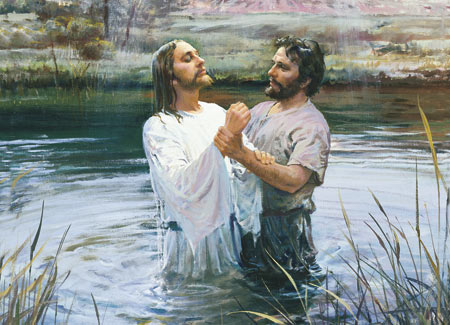
Mark 1:9 - Jesus' Baptism: More than Obedience

I am really enjoying this study (I'm also REALLY behind in blogging my daily thoughts. Sorry), taking the Bible verse by verse and really spending time thinking and reflecting on what is going on in the book of Mark. I am so thankful for attending the Priscilla Schirer simulcast a few months ago, as that is what inspired me to do this. I've read the Bible several times and each time there is always something new and compelling to learn, of course. But it's more than that. It's even how I've studied the Bible each time that makes a difference. Reading it in a "Read the Bible in a Year" plan, I get a nice overview. Listening to it on CD gives me the story as a whole--without the ability to stop and reflect--so I am forced to hear the whole thing in context. But this slow, inductive method really helps drive points home and gives me insight that I might otherwise have missed. Especially paraphrasing and writing down thoughts. Like. . .more and more thoughts come as I start to write. And then when I rewrite them again on this blog, it really helps to solidify what I've learned.


The Verse (NIV)


9 At that time Jesus came from Nazareth in Galilee and was baptized by John in the Jordan.


My paraphrase


9. Jesus begins His Messiahship with an act of humility: Baptism by John.


My thoughts


I think more than anything else, this verse explains Jesus' purpose for coming as "suffering servant." I know that's a weird thought to have at this, His baptism when He isn't suffering at all, but hear me out. John (the Baptist) just got through telling us that he was unworthy to touch Jesus' feet, but then here we are seeing Jesus go through an act that required repentance. Isn't that strange? Any time any person is heralded and lauded by another person, throughout Scripture or anywhere else for that matter, do you see the heralded person then act like a servant? I certainly can't think of any examples. We can't just look at this scene and go, "Well, of course Jesus behaved that way. That's what He was supposed to do." When we react that way, I think we miss something major. Why was He supposed to? Why was this an act of obedience? It's a weird thing for the perfect Son of God to do.


It's weird, of course, because ironically Jesus had nothing to repent over as He was without sin, yet He still acted in the obedience of baptism. I have heard a lot of commentators and teachers state that His baptism was an act of obedience because He is our example and so He was paving the way for future believers. . .But that still doesn't answer the why question. Not well at least. Future believers were, are, and will be sinners. Jesus is and was perfect, so why did He do it? 


I think the key to the question of why He behaved like a servant was because, in being baptized, He was foreshadowing His death (which He also didn't deserve)--an act that would put all sin upon Him. That is the only reason that makes any sense to me. When we get baptized, sometimes our baptizers will even say, "Buried in the likeness of His death. Raised in the likeness of His resurrection." I think that's why He did it. He was foreshadowing what would happen to Him--death, burial, and resurrection. In that way, yes, He was paving the way for us, but it's more than just a ritualistic expression of the start of a tradition. It was a paradigm shifting event. No longer did baptism merely mean an outward show of an inward cleansing. Now, Christ's life, death, burial, and resurrection were attached--the very stuff of salvation. Not that baptism equals salvation, but rather that baptism solidifies salvation. Baptism makes salvation concrete because it assumes the physical positions of the Christ who gives it all meaning.


One last thought--and this one really excites me because I've never had it before. Think of the significance of Christ being baptized in the Jordan River. I mean, think of everything that had happened there. How many battles? How many significant events? Jacob crossed it on his way back to Haran. The water that covered Jesus would have run over the sand that had once been dry ground for Joshua and the Israelites and also Elijah and Elisha. The Jordan needed to be crossed in order for the Israelites to reach the Promised Land. These same waters were used to cure Naaman of leprosy. That is just to name a few. . .Now think of Jesus' baptism. It was the start of Jesus stepping into His Messiah role--the role which gave every prior event its eternal meaning. More than stories on a page. Now the Promised Land meant heaven. Now the dry ground meant grace. Now the healing meant eternal life. It was the true fulfillment of everything else that ever happened or would happen in these same waters. All of them in that moment.


Sunday, May 29, 2016

Mark 1: 7-8 John the Baptist: It's Okay to Be Different. . .Icky Feet. . .God's Certainty. . .and Baptism: Water vs. Holy Spirit

I was told by a friend that when I colored these three sections--verses, paraphrase, and thoughts--I had made them very straining on the eyes, so. . .in an effort to make my posts more readable, I am just going to make the three sections different fonts. Maybe one day, I'll get this system down!


The Verses:(NIV)

7 And this was his message: “After me comes the one more powerful than I, the straps of whose sandals I am not worthy to stoop down and untie. 8 I baptize you with[e] water, but he will baptize you with[f] the Holy Spirit.”

My paraphrase:

7 This was his gospel: "The Messiah is coming and He is far greater than I am. 
8 I can baptize you with only water, but His baptism is the Holy Spirit."


My thoughts:

This verse completes the whole strange picture (You can scroll down to the former entry if you are wondering what strange picture I'm talking about). So here's this guy. He's in the middle of the desert. If you want to go see him, you're gonna have to stop your regular life and leave your comfort zone--by the way, it's the desert. When you get there, you see he's dressed like Fred Flintstone and yelling at you to give up being selfish and turn to God. By the way, this God he keeps yelling about hasn't actually talked to your or anyone you know and the last recording of His human interaction was over 400 years ago. Then, this same guy urges you to believe in a promised Messiah that no one has seen since the beginning of time. 

Then, to top it all off, this weirdo dunks you in a nasty river!

It's just like God to draw people to His message in the last way you'd ever expect!

It does make me wonder, though, if John--mid-dunking someone--ever had a self-aware moment going, "Wait. . .What in the world am I doing?. . .And why am I dressed like this?" Obviously, the fact that Mark bothers to describe him--when he's not a detail-oriented writer--proves that John is a little different.

What this means to me: If God had a plan for John to be different, then it's okay if God gives me a different plan from everyone else's. Sometimes, I feel like the crowd of believers around me has been called to a certain task. Should I join them just because it is a good thing? What if I haven't been called to join them? What if I have been called to study the book of Mark a little every day, for instance? I should probably do what I've been called to do and not what I haven't--even if it's a good thing. This doesn't mean I should find a sense of superiority in my given task, and it doesn't mean that I can only do one task and shun the others. It just means that God wants us to be a body of believers (eyes, ears, arms, etc.) not cookie-cutters, and that's okay. If I am using my task as an excuse to get out of doing another task, that is also not right, obviously. That's not my point. My point is John was different, so I can be different, and I don't need to feel guilty about being different.


Part of Verse 7 again: "I'm not worthy to untie his sandals." 

Dealing with a master's feet was the lowest job of a servant, and for logical reason. Feet are dirty and disgusting. They were back then, and they still are today. (Yes, I'm probably a bit of a germophobe. . .However. . .) Your feet gather all kinds of germs--from sludge, to fecal matter, to disease--and the gathering is completely unavoidable as walking is our general mode of daily transportation. 

John describes here that even if he were to perform the lowest act of servanthood for Jesus--something only the lowest of the low was expected to perform--that he would consider this humble act as infinitely disrespectful due to the superiority and divinity of Christ. This is no small thought, and we really should stop and think about it rather than gloss over it. Think again about it, this is John the Baptist we're talking about. Jesus Himself said that John was the greatest prophet ever to have lived! Yet, John considered himself unworthy even to touch Jesus' feet. This is a humbling thought. If you don't feel humbled, then ask yourself: Has Jesus ever called me the greatest prophet ever to have lived? My guess is, no, since that superlative description has already been designated to John. Furthermore, it should be even more humbling to think about how later in His ministry, Jesus Himself deigned to wash His disciples' feet. What pure humility is that? Unfathomable.


Another John thought:

The fact that God used John to prepare the way for Jesus shows me two things: (1) John had to appear because he was fulfilling prophecy, and (2) God always prepares his people for messages they should hear. John was immediate preparation for God's people to be ready to hear from His Messiah. Jesus wasn't out-of-the-blue. His coming was calculated and well-groomed. God never leaves us high and dry--expecting us just to guess His plans. He told His people in Isaiah and Malachi that a prophet would come to prepare the way, and that's exactly what happened. This shows us that God loves us. We may not know everything, but we always get to know exactly what we need to know, and we get to know it at just the right time. 

Contrast this with the total uncertainty of literally ANY other faith, religion, or belief system.


Regarding verse 8 (The part about baptizing with water vs. the Holy Spirit): 

John makes the point that he baptizes with water, but Jesus will baptize with the Holy Spirit. I imagine this sounded very nice, but also very cryptic to the hearers. "Baptize with the Holy Spirit?" What could that have meant to them? Up to that point, the Holy Spirit was something outside of themselves. He was a Spirit that would indwell those chosen followers who seemed to be elite--think of David or Moses or even King Saul at times--(Although they really weren't elite at all. They were literally just people like you and me, but you know how the enemy will get in your head and tell you that God has "special people" and that you might not be one of them?) I'm not saying that the hearers did think this way, I'm just asking the question, "How could people have possibly understood this statement?" Obviously, they did understand what they needed, because look how many people John reached. "The entire countryside of Judea and the city of Jerusalem." Look how many people repented as a result of his "cryptic" preaching. 

This shows me that God is far more awesome than the credit we give Him. He says things that can make a certain type of sense to the hearers of the time, but then the same statements mean a totally different--or maybe just deeper--type of sense to hearers afterwards.

Anyways, of all human beings, John had, arguably, the most right to feel full of himself. He could look at himself and his ministry and pat himself on the back. But he didn't. John made the observation that while he could preach and reach many many people--in the end, all he was doing was merely just "water." Water is good. Water is symbolic. Water can clean. Water is necessary for life. Water is, like...what? 75% of our bodies or something. However (and therefore), water is human. 

"But," as John says, "Stay tuned! There is one coming who will fulfill and explain all the symbolism and tradition and mysterious messages in Scripture! There is one coming after me who will cleanse you in a way that no dirt, grime, or filth can ever defile again! There is one coming who will slake your thirst once and for all! He comes with the Holy Spirit, and this is real power. Yes, repentance is the first step, but when He comes, you are going to want to repent! The life He will bring you will be such that there will be no going back, nor the desire to go back to who you used to be! What He brings you is eternal. It is pure. It is true. It is far greater than anything I could ever give you. It is divine. It is God Himself."


Tuesday, May 24, 2016

Mark 1:4-6 - John the Baptist. . .Jesus' Weird Homeschool Cousin


(Continuing my Bible Journaling of Mark. . .)

The Verses: 


Mark 1:4-6 - 4 And so John the Baptist appeared in the wilderness, preaching a baptism of repentance for the forgiveness of sins. 5 The whole Judean countryside and all the people of Jerusalem went out to him. Confessing their sins, they were baptized by him in the Jordan River. 6 John wore clothing made of camel’s hair, with a leather belt around his waist, and he ate locusts and wild honey. 


My Paraphrase:


4 - Following the Spirit, John lived in the desert, baptizing and calling people to repent.

5 - This attracted everyone from the surrounding areas and they obeyed this calling.

My Thoughts:


John obeyed God's calling on his life. I think we take for granted the obedience we see in Biblical characters. Did John struggle with his calling? Did he have a wayward adolescence? Or did he readily embrace the poverty and humility of his prophesied profession?


Whatever the case, because of his obedience, an entire city and countryside were attracted to his message--and an unlikely message to be so attracted to! Think about it, people turned from sin and selfishness, without the indwelling of the Holy Spirit, and agreed to be dunked underwater by a bug-eating nutcase in the desert! This shows me that the power of God--and specifically the power of obedience--is not something to take lightly. He is not impressed with showmanship or Pharisitical propriety AT ALL. If He can get people to listen to His message in such an unlikely way, none of us should ever feel prideful if people happen to turn their hearts to Him because of some "amazing" thing we did.


My Paraphrase:


6 - John dressed like a dirty hippy and ate bugs and honey.


My Thoughts:


Okay, so my paraphrase was kind of to make you laugh. . .but honestly. . .read how Mark himself writes it! Verse 6 is TOTALLY out-of-the-blue, non sequitur. It's almost like each verse builds on itself to make this crazy picture complete. First of all, John--as fulfillment of Scripture--is in the desert, baptizing, and calling people to repentance. Okay, great. . .Then--get this, guys--this message actually ATTRACTS tons of people from the main city and they actually OBEY this crazy message!. . .And then finally. . .wait for it. . .the climax: On top of it all, John has very questionable eating habits and dresses like a caveman! 


Seriously, read those verses again and see if that thought doesn't pop out at you as very odd. See, Mark is not the most detail-oriented writer (his gospel is the shortest, his statements are matter-of-fact, he lacks sentimental embellishment, etc.), and yet he bothers to tell us these strange details about how John is dressed and what he eats. I mean, do you just go around defining people like that normally? Is there ANYONE else in the Bible, for instance, who is described by dress code and diet? No. So obviously, Mark thought it was weird too!


I do think this description is to help us remember that God isn't interested in pride. . .However, did John really have to dress like a Jedi Knight? Or was he just having fun? Or was he just embracing the whole "prophet look" (apparently, Elijah and other prophets wore camel hair clothes)? After researching it a bit, I learned that it was actually a normal diet to eat bugs if one lived in the desert, and apparently locusts were on the list of "clean" things to eat. However, it does give one pause to think, 'Did John have to go to such lengths to prove his prophethood?' and 'Why did Mark bother to tell us these details if they were at all considered normal?' I guess we are to assume that even his appearance was an act of obedience since Jesus later calls him the greatest prophet ever to have lived.


Still. . .I can't help but love Ps. Mark Driscoll's assessment of John as "Jesus' weird home-school cousin"!!